Day 13
Study Design: Causal Claims
EPSY 5261 : Introductory Statistical Methods
Learning Goals
At the end of this lesson, you should be able to …
- Describe the benefits of randomly assigning participants to treatment groups.
Drawing Causal Conclusions from a Study
When can we make a causal claim?
- In a lot of research we are interested in making a causal claim.
- Example: This curriculum improved learning!
- To be able to make this claim we need to be confident there aren’t any other factors that actually influenced the outcome!
When can we make a causal claim?
To mitigate uncertainty about external factors we want to compare equivalent groups. {.v-center-container}
Ideally…
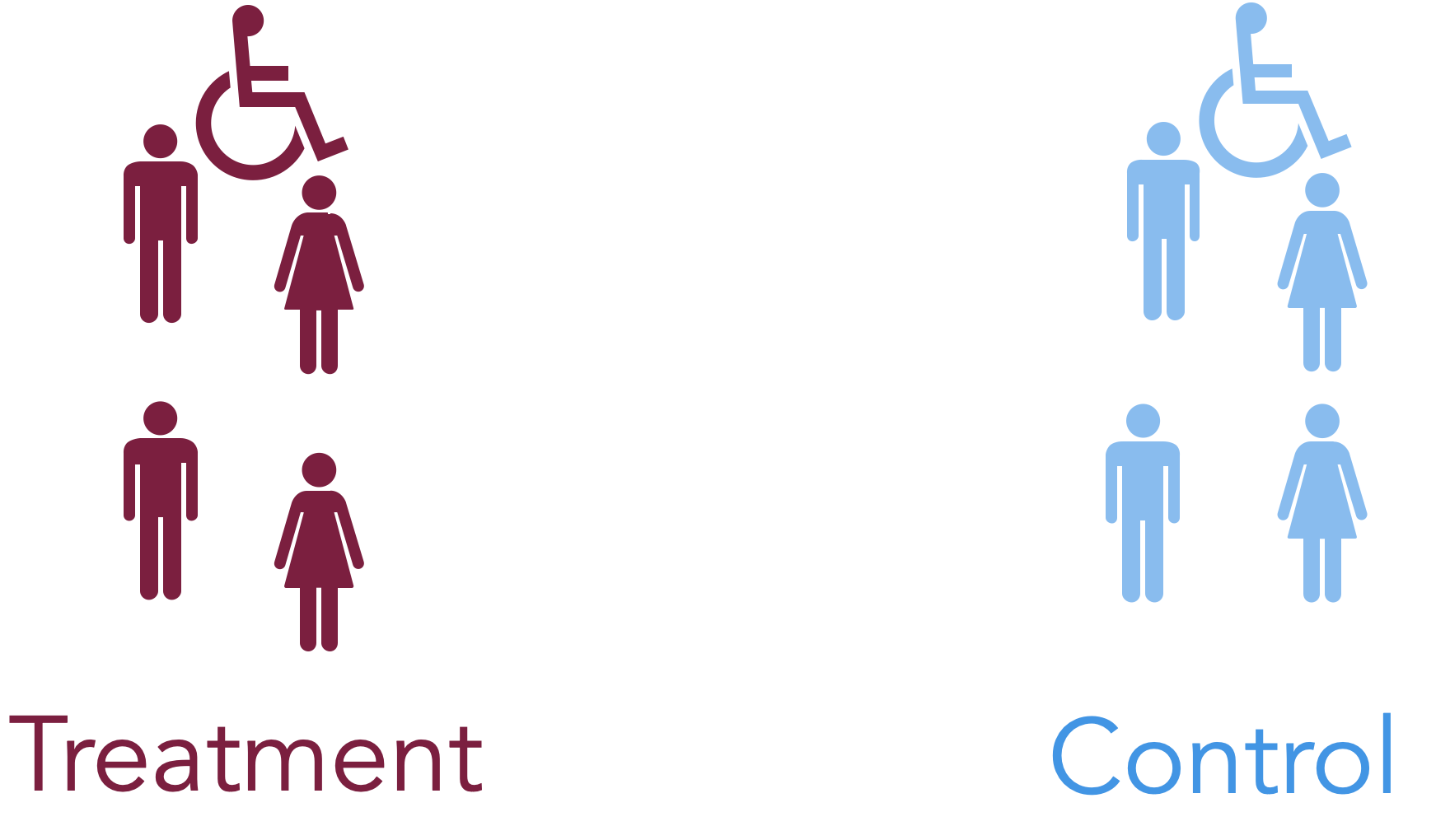
We have two identical groups (think identical twins). One group is given the treatment and the other isn’t (the control group—often given a placebo). That is the only difference between them.
![]()
If there is a difference between the groups in the end, we can be confident it was from the treatment!
Identical Groups?
- We can’t create identical groups … necessarily.
- Instead, we create probabilistically equivalent groups.
- a.k.a. Mathematically equivalent groups
- These groups are, on average, the SAME on all characteristics (observable and not observable).
- To do this we randomly assign people to be in the treatment group and the control/placebo group.
- You will explore this in an activity!
Random Assignment
- The process of random assignment creates, on average, groups that are “identical”.
- It doesn’t do this perfectly every time we create groups, but on average it does—and that is good enough!
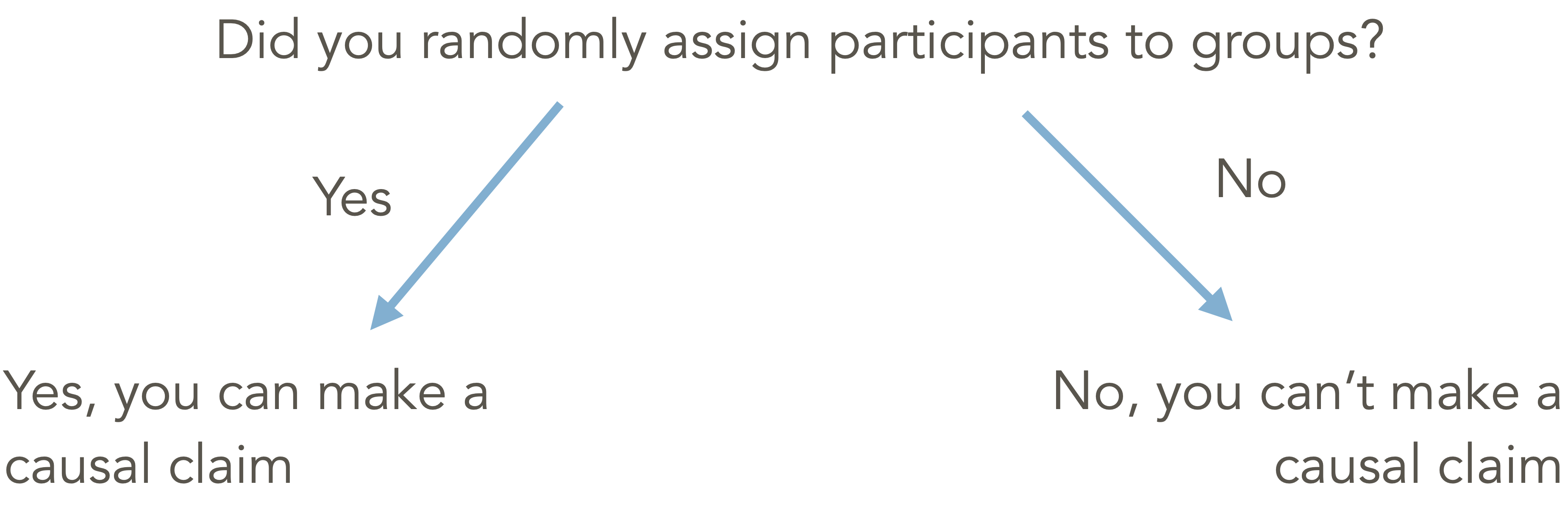
- Creating groups through random assignment is the gold standard for making causal claims.
- There are more advanced methods, but we won’t get to those in this course.
Can you make a causal claim?
![]()
Summary
- Randomly assigning participants to groups allows us to create groups that are probabilistically equivalent.
- This allows us to infer that our treatment was the only cause of a difference between the groups (if a difference is detected).
- Then we can make a causal claim
Social Media Activity